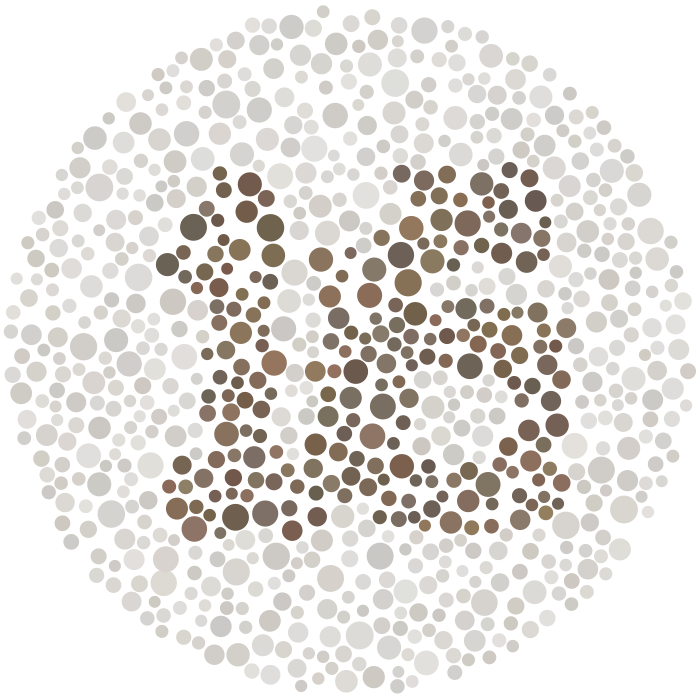
This color blind test shows you fourteen pseudoisochromatic plates — the dot-pattern style made famous by Ishihara screening — and reports how many hidden figures you recognize. The free color blind test takes about two minutes, needs no account, and every answer is processed inside your own browser. The plates cover the red-green axis that most color vision differences live on, the rarer blue-yellow axis, and one brightness control plate that checks your viewing conditions before the color blind test begins.
How this online color blind test works
Each plate in the color blind test is a field of small colored dots with a number or shape drawn in a second color family. People with typical color vision read the figure easily; people whose red-green or blue-yellow perception differs often see a different figure, a blurred smudge, or nothing at all. Your answers are compared with the pattern actually drawn — never with a medical label — and the result page counts how many figures you recognized per design group.
- 1Run the readiness checks: turn off night shift and system color filters, set comfortable brightness, and sit about 50–70 cm from the screen.
- 2Work through the 14 plates in order; type the number you see or press "I can't see it" — there are no wrong answers, only observations.
- 3Read your descriptive result: figures recognized on red-green designs, blue-yellow designs and the control plate, grouped exactly as you answered them.
- 4Retake the color blind test any time; plates are regenerated from fixed seeds, so the same test is reproducible on every visit.
What this color blind test can and cannot tell you
A color blind test like this one is a screening experience, not a diagnosis. The result describes pattern recognition on this screen, under your lighting, today. Screen calibration, ambient light, screen age and even dark-mode settings can all shift how plates appear — a research team comparing Ishihara plates across smartphones and calibrated displays measured meaningful differences between devices (Kim et al., 2024).
The three plate families inside the test
The color blind test draws on fourteen original plate definitions published under an MIT license by the Color Vision Plates project. Every plate's colors, answer and design group are public and reproducible.
Red-green plates — the core of any color blind test
Ten of the fourteen plates probe the red-green axis: five general designs that most color blind test takers find informative, plus two protan-directed and two deutan-directed experimental designs. The directed plates use color pairs chosen so the figure tends to vanish for one red-green subtype while staying visible for the other — which is why they are interesting, and also why they stay labeled experimental.
Blue-yellow plates for the tritan axis
Four plates use blue-yellow confusion pairs that target tritan-type vision, which affects well under 0.02% of people. If you only struggle with these, check your screen first: cheap or badly calibrated displays often distort blues before any vision difference is involved. The color blind test keeps these plates in their own group so a single tricky blue never dominates your result.
The control plate that guards the color blind test
The first plate is a brightness-contrast design that virtually everyone can read. If you cannot read it, the session is marked uninterpretable — that protects you from drawing conclusions from a screen or setting problem rather than from color vision. It is a small honesty check that most color blind test pages skip.
- ~8%
- of men with Northern European ancestry have some red-green color vision deficiency NEI
- ~0.5%
- of women are affected — the genetics sit mostly on the X chromosome NEI
- 14
- plates in this color blind test: 1 control, 5 red-green, 4 protan/deutan-directed, 4 blue-yellow
Prevalence figures from the U.S. National Eye Institute; plate counts from this test's published manifest.
Preparing your screen for the color blind test
Online plates are only as good as the display they travel through. Before you start the color blind test, spend thirty seconds on the setup — it materially changes how readable the designs are.
- Disable Night Shift, True Tone, blue-light filters and any operating-system color filters.
- Use normal room lighting — not a dark bedroom, not direct sunlight on the screen.
- Keep brightness at a comfortable mid level; washed-out plates hide the subtlest figures.
- Clean your screen and view it straight-on; strong viewing angles shift colors on LCD panels.
Curious how colors change for different vision types instead of testing yourself? The color blind simulator renders any image through protan, deutan and tritan simulation, entirely on your device. Parents can try the shape-based color blind test for kids, and anyone who wants the classic digit experience can take the Ishihara color blind test next.
Color blind test FAQ
Q1Is this color blind test free?
Yes — completely free, with no account, no email and no ads on the test itself. The project is built on open-source plate definitions, so there is nothing to upsell.
Q2How accurate is an online color blind test?
It is a useful screening signal, not a clinical instrument. Clinical color vision exams use standardized, validated plates or arrangement tests under controlled lighting. Treat your result here as a reason to seek — or postpone — a professional exam, not as a verdict.
Q3Can a color blind test detect my type — protan, deutan or tritan?
The result page shows which design groups you recognized, and the directed plates lean toward specific subtypes. But two experimental plates per subtype cannot establish a diagnosis, so the report describes patterns seen rather than naming a condition.
Q4Why did I see different numbers on some plates?
That is expected plate behavior: confusion colors are chosen so altered red-green perception reads a different figure — for example a 3 read as an 8. Note what you genuinely saw; the comparison with the drawn pattern is what makes the test informative.
Q5Does the color blind test work on phones and tablets?
Yes. The layout adapts down to small phones, and the plates render at your device's native resolution. The same display advice applies: kill night shift, avoid glare, and keep brightness reasonable.
Q6Are my answers stored anywhere?
No. Answers live in the page you have open and disappear when you close the tab. There is no backend receiving results — you can watch the network panel stay silent while you test.
Q7What should I do if the color blind test suggests a difference?
Book a clinical color vision exam with an optometrist or ophthalmologist, especially if the outcome affects career, licensing or school decisions. Bring a note of which plate groups felt hard; clinicians can run validated tests like Ishihara booklets or the FM100 in minutes.