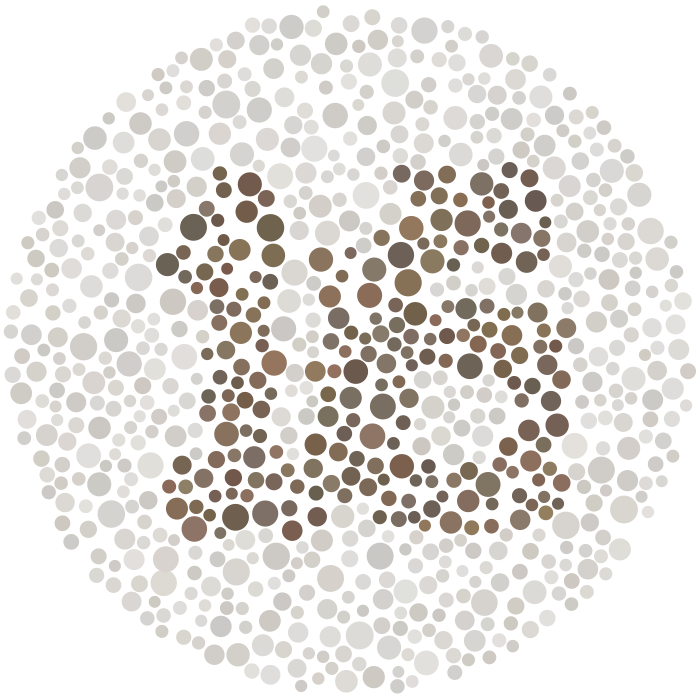
The Ishihara color blind test is the format everyone pictures: a circle of mottled dots with a number printed inside in a second color family. This Ishihara color blind test runs nine such digit plates, generated by a seeded open-source algorithm so every visitor sees exactly the same test — plate for plate, dot for dot. It is the classic red-green screening experience, and the whole color blind test takes about ninety seconds.
What "Ishihara-style" means in this color blind test
In 1917, Japanese ophthalmologist Shinobu Ishihara published a set of pseudoisochromatic plates to screen soldiers for red-green deficiencies. The design principle still defines the genre: scatter dots of randomized size and lightness across two color families, draw the figure with one family and the background with the other, and rely on the fact that deficient red-green perception collapses the two families into near-identical appearance. An Ishihara color blind test built on this principle behaves like the original — but the plates in this Ishihara color blind test are NOT scans or copies of the copyrighted printed booklet.
Our plates come from the MIT-licensed `ishihara` Python generator by Vincent Gonzalez: each digit plate is grown from a fixed seed, which fixes the dot layout, the color palette and the answer. The same seed always yields the same plate, so the test is reproducible in a way random per-visit generators are not — you can even verify the checksums of every SVG on our licenses page.
How the Ishihara color blind test scores your answers
- 1One control plate printed in brightness-contrast colors opens the test — if you cannot read it, your screen or settings make the session uninterpretable.
- 2Eight red-green digit plates follow, one at a time; type the number you actually see, or press "I can't see it".
- 3The result page reports how many figures you recognized — red-green designs as one group — with no diagnosis, subtype or percentage.
- 4Retake as often as you like; the plates are identical each time, so repeated exposure can train your answers — worth knowing before your second run.
Deliberately, this Ishihara color blind test never claims clinical accuracy. The original 24- and 38-plate books are validated instruments administered under standardized daylight illumination. A browser plate set on an uncontrolled screen is a screening experience — strong signal, no verdict. The U.S. National Eye Institute describes pseudoisochromatic plates as one screening method among several that clinicians combine (NEI, testing color vision).
Reading the plates of the Ishihara color blind test like a clinician
Digits that transform under red-green deficiency
Classic Ishihara color blind test logic includes transformation plates: a person with typical vision reads 74 where a red-green deficient reader reads 21, or reads 3 where the deficient reader sees 8. Our generator produces single-axis red-green plates rather than deliberate transformation pairs, so the meaningful signal in this Ishihara color blind test is figures that blur, vanish or get misread — and the control plate that anchors the session.
What a misread on the Ishihara color blind test means
One misread plate means little — screen glare and stale panels cause single misses constantly. A run where most red-green plates of the Ishihara color blind test blur is a reasonable prompt to book a clinical exam, especially before occupational screening for aviation, railway, electrical or maritime roles where formal color standards apply.
Why blue-yellow plates are not in this set
The Ishihara color blind test is a red-green instrument by design; its confusion palettes say nothing reliable about tritan (blue-yellow) vision. We keep the axes separate on principle. For that axis use the tritan color blindness test.
- 1917
- year Shinobu Ishihara published the first pseudoisochromatic plate set
- 9 plates
- in this Ishihara color blind test: 1 control + 8 red-green digit plates
- ~90 sec
- typical completion time — fast enough to retake after fixing screen settings
- ~8%
- of men carry a red-green difference — the population these digit plates are built to screen NEI
The Ishihara test's historical scope and this implementation's boundaries.
Preparing for the Ishihara color blind test online
- Disable night shift, blue-light filters and system color filters before the Ishihara color blind test — warm tints mimic deficiency.
- Clean the screen, use moderate brightness in normal indoor light, and avoid direct reflections.
- Wear your usual corrective lenses, but remove tinted or anti-blue-light glasses.
- Answer the Ishihara color blind test with your first honest impression; guessing sharp digits defeats the measurement.
Related experiences: the online Ishihara test variant of this same engine, our full 14-plate color blind test, and the color blind simulator for seeing any photograph under simulated color vision.
Ishihara color blind test FAQ
Q1Is this the official Ishihara 38-plate test?
No. The official booklets are copyrighted clinical instruments sold under controlled printing standards. This Ishihara color blind test uses original, open-source generated plates that follow the same pseudoisochromatic principle.
Q2Are the plates the same every time I take the Ishihara color blind test?
Yes. Each plate of the Ishihara color blind test is generated from a fixed seed, so layout and colors are byte-identical across visits and devices. Reproducibility is a feature: your first and second runs differ only through you, not through refreshed dots.
Q3How many plates should I get right on the Ishihara color blind test?
On a well-set display, readers with typical red-green vision generally read most digit plates. The control plate must be readable or the session is void. There is no official pass mark for an unvalidated online set — read the group counts as information, not a grade.
Q4Can I use this Ishihara color blind test for a job or license application?
No. Aviation, maritime, rail and similar bodies accept only certified clinical instruments such as printed Ishihara books under controlled illumination, anomaloscopy, or approved digital devices. Use this page for curiosity and self-awareness.
Q5Why do the dots look different from the printed Ishihara book?
Printed plates use ink on paper under daylight lamps; screens emit light through differently-spaced subpixels. A 2024 comparison of Ishihara tests across display types found measurable differences — one more reason online results stay descriptive.
Q6My child cannot read digits yet. Is there an Ishihara-style alternative?
Yes — the color blind test for kids uses shape plates (circle, star, triangle, heart) so no reading is required at all.