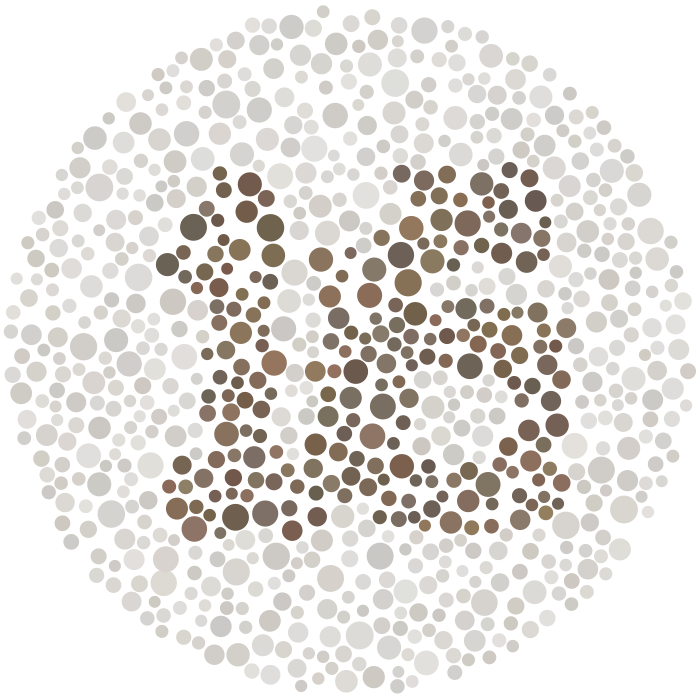
A red and green color blind test concentrates on the axis where nearly all inherited color vision differences live, and this red and green color blind test runs the full dedicated set. This page runs the ten red-green plates from our fourteen-plate set and drops everything else: one brightness control plate, five general red-green designs, two protan-directed and two deutan-directed experimental plates. If reds, greens, browns and oranges have always negotiated awkwardly in your life, this is the focused instrument.
What the red and green color blind test reveals
Red-green deficiency splits into two families. Protan-type vision shifts long-wavelength sensitivity — reds look darker and desaturated, deep red can vanish toward black, and purple confuses with blue. Deutan-type vision shifts the medium-wavelength greens — the classic "red and green look alike" experience, with greens browning out and oranges reading dull. A red and green color blind test cannot separate these families with certainty, but the directed plates give each its own score group so you can see your pattern.
The general plates in the red and green color blind test
Five designs use balanced confusion pairs with a* separations from 54 down to 32 in CIELAB terms — strong pairs first, subtler pairs later. The subtle star plate at the end is the friend of anomalous trichromats: people with mild shifts often pass the bold plates and stumble exactly where the color difference between figure and background shrinks.
Protan-directed and deutan-directed plates
Four plates use color pairs found via Brettel-simulation grid search: the digit 3 and 7 plates tend to fade for protan-type vision while staying readable for deutan-type, and the 9 and 4 plates behave the other way around. Two plates per subtype is a directional signal, never a verdict — the red and green color blind test reports them as separate experimental groups precisely so they cannot be over-read.
The control plate
Plate one is pure luminance contrast — dark on light, essentially colorless. If it fails, your screen or its settings are the story, and the session reports uninterpretable instead of blaming your vision. It is the cheapest possible insurance a red and green color blind test can carry against night-shift false alarms.
Where red-green differences show up in daily life
People taking a red and green color blind test often arrive with a specific frustration: traffic-signal lights at distance, ripe-versus-raw fruit, red meat doneness, colleagues' red laser pointers on charts, error states in dashboards, the classic pink-vs-gray steak argument, weather radar, school mark-ups in red pen. The red and green color blind test exists to turn vague suspicion into a recognizable pattern. Recognition matters more than correction — once the red and green color blind test shows you your pattern, adaptations (labels, positions, luminance cues) are straightforward.
- Driving: signal lights are positioned in a fixed order precisely because color alone is unreliable for many drivers.
- Work: electricians, rail and aviation staff face formal color standards — preview your pattern before the official exam.
- Learning: red ink on pink paper or green-on-red charts are quietly hostile to a red-green deficient reader.
- Design: if you build interfaces, check them with the color blind simulator afterward.
Honest limits of this red and green color blind test
Display conditions move red-green plates more than any others: a warm white point compresses exactly the red-green differences this red and green color blind test depends on. Published research comparing Ishihara plates across device types found systematic readability shifts (Kim et al., 2024) — so set up your screen before judging your red and green color blind test result.
Related pages: the digit-based Ishihara color blind test, the full 14-plate color blind test, and the blue yellow color blind test for the other axis.
Red and green color blind test FAQ
Q1Why does a red and green color blind test use green dots for red numbers?
Because the confusion is the point. In the red and green color blind test, figure and background families sit along the red-green confusion line, so typical vision separates them by hue while deficient vision must fall back on lightness and size cues — which the dot randomization deliberately blurs.
Q2Can this red and green color blind test tell protan from deutan?
It shows a directional pattern: the protan-directed group versus the deutan-directed group. With two experimental plates per subtype, that pattern is a hint for discussion with an eye-care professional — not a classification.
Q3Why did I read some numbers wrongly instead of seeing nothing?
Transformation is normal plate behavior — a 6 read as 0, a 3 read as 8 — because confusion colors let a wrong figure emerge. Your answer is compared with the drawn pattern; misreads and blanks both count as not-recognized in the red and green color blind test.
Q4I only failed the subtle plates. Is that a mild deficiency?
It is consistent with a mild shift, with a tired or mediocre screen, or with glare. Retake once on a second display before concluding anything from the tail end of the red and green color blind test.
Q5Are red-green deficiencies equally common everywhere?
Prevalence varies with ancestry — the often-quoted ~8% figure describes men of Northern European descent; several East Asian and African populations measure somewhat lower, and isolated communities can measure much higher through founder effects.
Q6Should children take the red and green color blind test?
Digit plates suit confident readers; younger children do better with the shape-based color blind test for kids, which needs no reading at all.