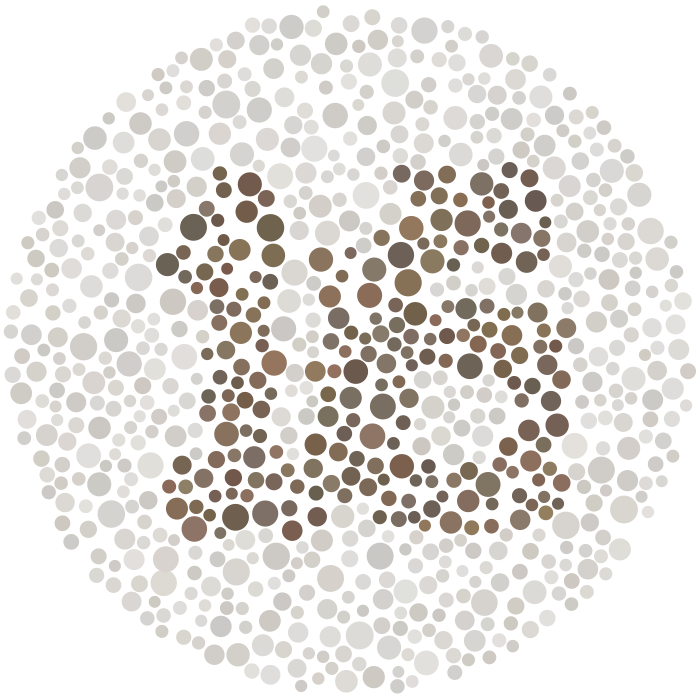
This color blind test for kids replaces digits with shapes — a circle, star, triangle or heart hides in every plate, and your child answers by tapping the matching button. No reading, no counting, no keyboard: if your child can point at a shape, they can take this color blind test for kids. Eight plates take about three unhurried minutes with a grown-up alongside.
How the color blind test for kids works
Each plate is the same pseudoisochromatic principle as adult tests — a figure drawn in one dot family on a confusion-colored field — except the figure is a friendly shape. The first plate is a brightness-contrast control every child should see; the seven that follow use red-green color pairs scaled to be engaging rather than clinical. The color blind test for kids ends with encouragement and a shape count — never a label, because a color blind test for kids is exploration first.
Why shapes instead of numbers for kids
Digit plates quietly mix two skills: number recognition and color discrimination. A four-year-old who misses "74" might simply not read digits yet — the plate learned nothing about vision. Shapes remove that confounder, which is the same reason pediatric screening in clinics uses shape-based books like the Ishihara test for children or the CVME. This color blind test for kids follows the same logic.
The grown-up's role in the color blind test for kids
Sit at the screen together. Name the four shape buttons aloud once — circle, star, triangle, heart — then let your child answer alone, praising honest "I can't see it" answers as much as correct ones. Children read our expressions better than plates; if you wince at a miss, they will start guessing to please you. The tool includes a short guardian note on screen before every run.
- ~1 in 12 boys
- carries an inherited color vision difference — roughly one per average classroom NEI
- 8 plates
- in this color blind test for kids: 1 brightness control + 7 red-green shape designs
- age 4+
- is when shape-based screening usually becomes workable at home
- ~8%
- of boys carry an inherited color vision difference — roughly one per average classroom NEI
Pediatric color vision in numbers.
Why parents run a color blind test for kids
Most children with inherited color differences have no idea — they assume everyone sees as they do, and compensate automatically. It usually surfaces through small collisions: reading red marker on whiteboard, sorting crayons, "the grass is brown" remarks, PE bibs, or a geography worksheet whose legend relies on red vs green. An early, informal picture from a color blind test for kids lets you adapt materials early and mention it to teachers before grades depend on color-coded information.
- Tell the teacher: "color-coded charts may not read the same for them" — that single sentence changes a school year.
- Prefer labeling and position over color keys at home and in homework apps.
- Keep it neutral: a different way of seeing, not a defect — kids absorb framing fast.
- Recheck around age 8–10; school-age screening programs often do exactly this.
Setting up the color blind test for kids
- 1Tablet or laptop on a table, child at arm's length, room lights normal — not a dark bedroom.
- 2Night shift and blue-light filters off (check both the device and any parental-control color modes).
- 3Do the first plate together as practice; then let your child drive, you observe.
- 4Record nothing beyond memory — answers vanish when the tab closes, by design.
When your child is older and comfortable with digits, the Ishihara color blind test and the full color blind test await. Grown-ups curious about their own vision can start there, or explore the color blind simulator to see how their child's world might look.
Color blind test for kids FAQ
Q1What age is right for a color blind test for kids?
Shape plates work from about age four, whenever your child reliably names circles, stars and triangles. Younger toddlers can try this color blind test for kids, but expect attention — not vision — to be the limiting factor. Formal screening typically happens at school age anyway.
Q2Can this color blind test for kids give a diagnosis?
No. It counts hidden shapes found — an experience, not a medical result. Diagnosis in children belongs to pediatric optometry with validated shape plates under controlled conditions. Use this to notice patterns and prepare questions.
Q3My child missed two shapes. Should I be concerned?
Two misses out of seven is weak evidence — attention drifts, screens misbehave, single plates are noisy. Rerun the color blind test for kids once on another day and device. Consistent difficulty across runs is worth a pediatric mention; one session is not.
Q4Is the color blind test for kids free and private?
Yes — no account, no ads, and nothing uploaded. Children's answers stay in the browser tab, which is the only privacy policy a kids' tool needs.
Q5Which colors does the kids test check?
The seven scored plates use red-green confusion pairs — the axis of nearly all inherited childhood differences. Blue-yellow (tritan) issues are extremely rare in children and usually deserve direct medical attention rather than online plates.
Q6Should I correct my child during the test?
Never correct answers mid-test — the data is their honest perception. Praise engagement, stay flat about right and wrong, and discuss the pictures afterward using the reveal if you like.
Q7Can schools use this color blind test for kids?
As an awareness activity, sure — it runs in any browser. For screening programs, schools should use validated pediatric instruments and refer concerns to eye-care professionals.